

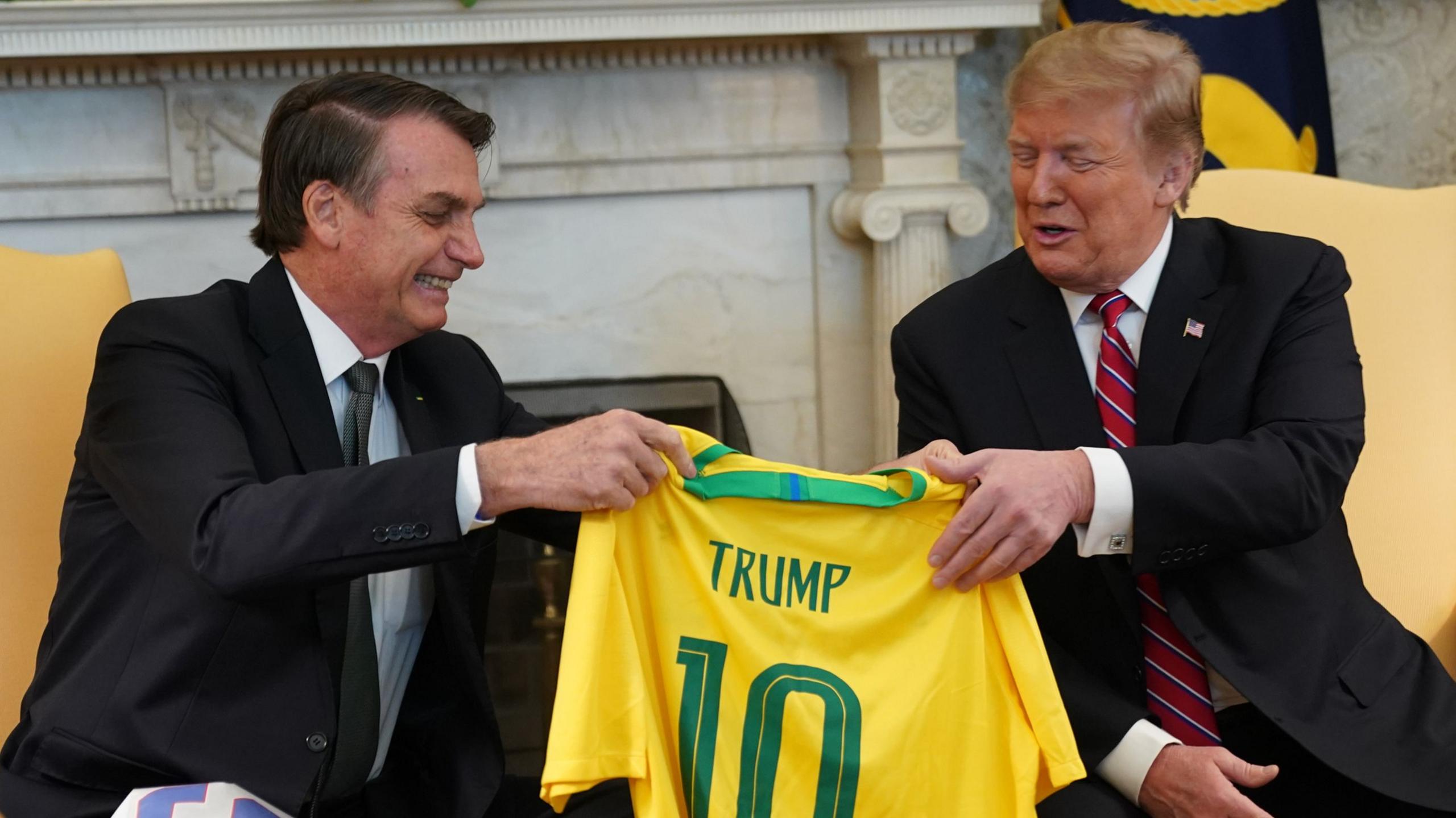
Former President of the United States, Donald Trump, has stepped up to support Jair Bolsonaro, Brazil’s former president, criticizing the legal actions against him as a “witch hunt” driven by politics. Trump’s statements, expressed through social media and later public engagements, have ignited a global discussion about the overlap of politics, justice, and democracy in both the United States and Brazil.
The comments came as Bolsonaro, Brazil’s former right-wing president, faces mounting legal challenges in his home country. Investigations into his role in the events surrounding the January 8, 2023, attacks on Brazil’s Congress, Supreme Court, and presidential palace—acts widely seen as an attempted insurrection—have led to a growing number of legal inquiries. Brazilian authorities are examining whether Bolsonaro, who was out of the country at the time, played any role in encouraging or failing to prevent the violent uprising staged by his supporters following his electoral defeat.
Trump, famous for his strong political ties with Bolsonaro, rejected the legal examination as an unwarranted attack on a political leader who, according to him, supported conventional values and stood against the growth of progressive politics in Latin America. Comparing it to his own legal challenges in the United States, Trump portrayed the scenario as part of an international trend where, he asserts, conservative figures are unjustly singled out by investigations driven by political agendas.
In his speech, Trump mentioned that Bolsonaro, much like him, embodies the people’s will and has fallen prey to what he called “radical left” political forces bent on quelling dissent. He contended that the legal issues confronting Bolsonaro are not just unjustified, but they also harm Brazil’s democratic structures by diminishing faith in the impartiality of judicial processes.
Trump’s remarks swiftly grabbed attention both in Brazil and around the world, introducing extra complications to an already intricate legal and political turmoil in South America’s biggest democracy. Bolsonaro’s backers have appreciated Trump’s involvement, considering it as confirmation of their view that the past Brazilian president is being unjustly criticized for political motives. On the other hand, detractors have claimed that Trump is meddling in another country’s domestic matters and compromising judicial autonomy.
The similarities between Trump and Bolsonaro have been frequently observed by political commentators. Both leaders have fostered populist personas, stressed nationalist language, and portrayed themselves as outsiders challenging what they label corrupt political elite. Each also confronted widespread demonstrations, disputed election results, and were accused of urging or not denouncing violent acts by their followers intended to disrupt democratic systems.
In Brazil, the investigations into Bolsonaro have intensified over the past year. Authorities are looking into several allegations, including his potential role in spreading false claims about election fraud, his alleged encouragement of anti-democratic protests, and his broader conduct while in office. The January 8 attack on Brazil’s key government institutions is considered by many to be the culmination of months of inflammatory rhetoric that sought to delegitimize the electoral process after his narrow loss to President Luiz Inácio Lula da Silva.
The Supreme Electoral Court of Brazil has made decisions that bar Bolsonaro from standing in elections until at least 2030, due to charges of political power abuse and using state media to disseminate false information. Additionally, the ongoing criminal investigations might result in harsher penalties, such as imprisonment, if it is proven that Bolsonaro participated in activities aiming to undermine Brazil’s democratic system.
Trump’s choice to openly support Bolsonaro highlights not just their individual political partnership but also a wider ideological connection among international right-wing groups. Both figures have promoted stories of being targeted, claiming that institutional powers—be they judicial, political, or media—work to silence opposing conservative opinions. This discourse has played a crucial role in keeping the dedication of their political supporters, despite facing significant legal challenges.
The reaction within Brazil to Trump’s defense of Bolsonaro has been sharply divided. Bolsonaro’s supporters have embraced the comparison to Trump, viewing both figures as symbols of resistance against what they perceive as creeping authoritarianism by left-leaning governments. They argue that the legal actions against Bolsonaro are not motivated by justice but by a desire to crush political opposition and consolidate power.
Opponents of Bolsonaro, however, view the comparison with Trump as further evidence of the danger posed by populist leaders who undermine democratic institutions, question the legitimacy of elections, and embolden extremist behavior among their followers. Many Brazilians see the investigations as a necessary and lawful response to an unprecedented assault on their country’s democratic framework.
Legal professionals in Brazil have emphasized that the inquiries are based on current legal structures aimed at safeguarding democratic governance and avoiding the repetition of political violence. They assert that ensuring public officials are responsible for their conduct—particularly after anti-democratic incidents—is crucial for upholding the rule of law.
The global aspect of the scenario is also significant. The way Brazil is dealing with the Bolsonaro investigations is being observed closely by other countries, especially as worries increase about the worldwide surge of populist movements and political divides. The manner in which Brazil’s judicial system navigates the fine line between holding individuals accountable and maintaining political impartiality could establish crucial precedents for other democracies confronting similar issues.
In the United States, Trump’s remarks about Brazil highlight his persistent attempts to present himself as an international advocate for nationalist populist movements. It also emphasizes his continual endeavors to portray his legal challenges—including several charges linked to his purported attempts to contest the 2020 U.S. presidential election—as driven by political motives. By associating with Bolsonaro, Trump strengthens his story of being targeted while engaging right-wing audiences globally.
Both Trump and Bolsonaro have developed significant online audiences, leveraging social platforms to circumvent traditional news outlets and speak directly to their followers. This approach has been crucial in preserving their political influence, even when not holding office or facing legal challenges. The online engagement of their supporters, at times, has played a role in inciting social upheaval and escalating political discord.
The broader implications of this transnational alignment of populist leaders are significant. Political analysts warn that the normalization of claims of election fraud, the questioning of judicial legitimacy, and the incitement of political violence could erode democratic norms not just in individual countries but globally. When powerful political figures dismiss legal accountability as mere persecution, it can undermine public trust in democratic institutions.
As the investigations into Bolsonaro continue, Brazil faces a critical juncture. The decisions made by prosecutors, judges, and political leaders will not only shape the country’s immediate political future but also influence global perceptions of how democracies respond to internal threats. Whether Bolsonaro faces criminal penalties or political rehabilitation remains to be seen, but the legal process is likely to be lengthy and politically charged.
For Trump, showing support for Bolsonaro aligns with his overall approach of addressing conservative voter concerns, framing legal repercussions as political tools, and presenting himself as a global emblem of opposition to liberal governments. It is uncertain if this connection will produce measurable political advantages, but it highlights the lasting impact of populist stories in today’s international politics.
As Brazil’s institutions deal with the legal and political consequences of the January 8 attacks, the task will be to maintain the tenets of democracy, hold accountable those responsible for any misconduct, and withstand the divisive influences that have challenged democratic strength in both Brazil and other countries globally.
The coming months will be critical in determining not only Bolsonaro’s fate but also the strength of democratic governance in a region that has historically struggled with political instability. Meanwhile, Trump’s intervention serves as a reminder that in today’s interconnected world, the battles over democracy, justice, and power often transcend national borders.