

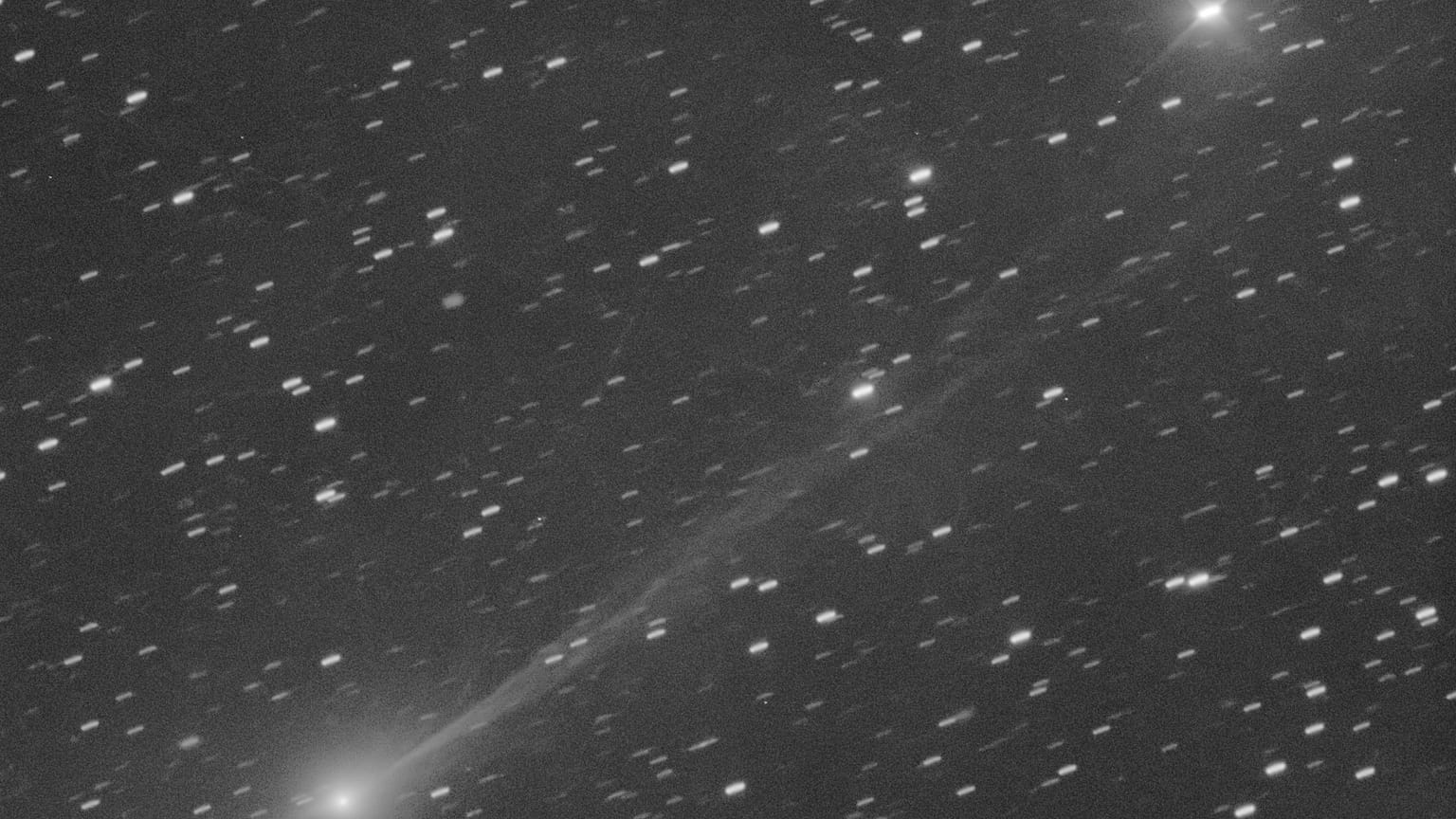
New images of the interstellar comet 3I/ATLAS nearing Earth have been captured by astronomers
New insights into comet 3I/ATLAS highlight its distinctive composition and active tails as it approaches its nearest point to Earth this month. The interstellar traveler, hailing from outside our solar system, has captivated scientists’ attention since it was first identified in July 2025.
Comet 3I/ATLAS represents just the third interstellar object identified as it journeys through our solar system, rendering each observation vital for comprehending its path, makeup, and actions. Detailed images of the comet have been captured by both the Hubble Space Telescope and the European Space Agency’s Jupiter Icy Moons Explorer (Juice) mission, providing unparalleled insight into this extraordinary cosmic event.
The comet’s teardrop-shaped coma is unveiled by Hubble
Hubble initially captured images of 3I/ATLAS soon after it was identified in July 2025, at a distance of approximately 277 million miles from Earth. Employing its Wide Field Camera 3, Hubble recorded a unique teardrop-shaped dust halo emanating from the comet’s frozen core. This luminous envelope of material emphasizes the continuous sublimation of gases and particles as the comet heated up while nearing the sun.
Observations persisted on November 30, when the comet was 178 million miles (286 million kilometers) away from Earth. Hubble obtained even more precise images, enabling astronomers to examine the comet’s changing form and gas emissions with increased detail. These images are crucial for monitoring the comet’s trajectory and comprehending how interstellar objects react when subjected to the sun’s energy.
Juice spacecraft captures dual tails
While Juice’s main goal is to examine Jupiter and its largest moons—Ganymede, Callisto, and Europa, which might harbor subsurface oceans that could sustain life—it utilized its path to observe comet 3I/ATLAS in early November. From approximately 41 million miles (66 million kilometers) away, the spacecraft employed five scientific instruments and its onboard Navigation Camera (NavCam) to document the comet’s activity.
The spacecraft transmitted a portion of the NavCam data ahead of the full download schedule. The images reveal a bright coma enveloping the comet, along with two distinct tails: a plasma tail consisting of electrically charged gases and a fainter dust tail of solid particles. This dual-tail structure is characteristic of comets within our solar system, but observing it on an interstellar object provides valuable clues about its physical and chemical properties.
Juice’s full dataset, expected to arrive on Earth between February 18 and 20, will include high-resolution images, composition analysis, and particle measurements. These data could shed light on the comet’s origin and the environment it traveled through before entering our solar system.
Close approach to Earth and visibility
Comet 3I/ATLAS is anticipated to come within 167 million miles (270 million kilometers) of Earth on December 19, situating it on the far side of the sun and presenting no danger to our planet. To put this in perspective, Earth orbits at approximately 93 million miles (150 million kilometers) from the sun, underscoring that the comet will stay safely remote while remaining visible to telescopes and space missions.
Even after its closest approach, the comet is expected to remain visible for several months as it continues its journey out of the solar system. Observations during this period will allow scientists to monitor how the comet interacts with solar radiation and the solar wind, further contributing to our understanding of interstellar bodies.
Understanding the Beginnings of Interstellar Phenomena
Studying 3I/ATLAS provides a rare window into material formed outside our solar system. The comet’s icy core, enveloped in a halo of dust and gas, may contain clues about the chemical makeup of distant star systems. The tails, driven by heat and solar radiation, allow researchers to examine how volatile compounds react when exposed to the sun.
Every interstellar visitor brings unique opportunities to compare our own solar system’s formation with that of other star systems. By analyzing the composition of 3I/ATLAS, scientists hope to uncover information about the types of materials that exist in other parts of the galaxy and how they evolve over time.
Future observations and research potential
The data collected by Hubble and Juice represent only a portion of the potential insights this comet can provide. Upcoming observations from both ground-based and space-based telescopes will help track the comet’s motion, measure its brightness variations, and refine models of its trajectory.
As additional data are received from Juice, scientists expect to gain insights into the dispersion of dust and gas within the coma and tails, the dimensions and spin of the comet’s nucleus, and possible isotopic markers that might unveil the interstellar environment it emerged from. These discoveries could broaden our comprehension of planetary formation, interstellar chemistry, and the frequency of comets moving between star systems.
The singular chance offered by 3I/ATLAS highlights the significance of synchronized observations from various space missions. By merging high-resolution imaging from Hubble with in-situ data from Juice, researchers are able to construct a detailed depiction of an object that has journeyed through the galaxy to arrive at our solar system.
In conclusion, comet 3I/ATLAS offers an extraordinary glimpse into the wider universe beyond our solar system. Its teardrop-shaped coma, dual tails, and interstellar origins provide invaluable data for astronomers, while its safe approach allows continued observation from Earth. The ongoing analysis of images and measurements from Hubble and the Juice spacecraft promises to deepen our understanding of how interstellar objects behave, paving the way for future discoveries about the cosmos.