

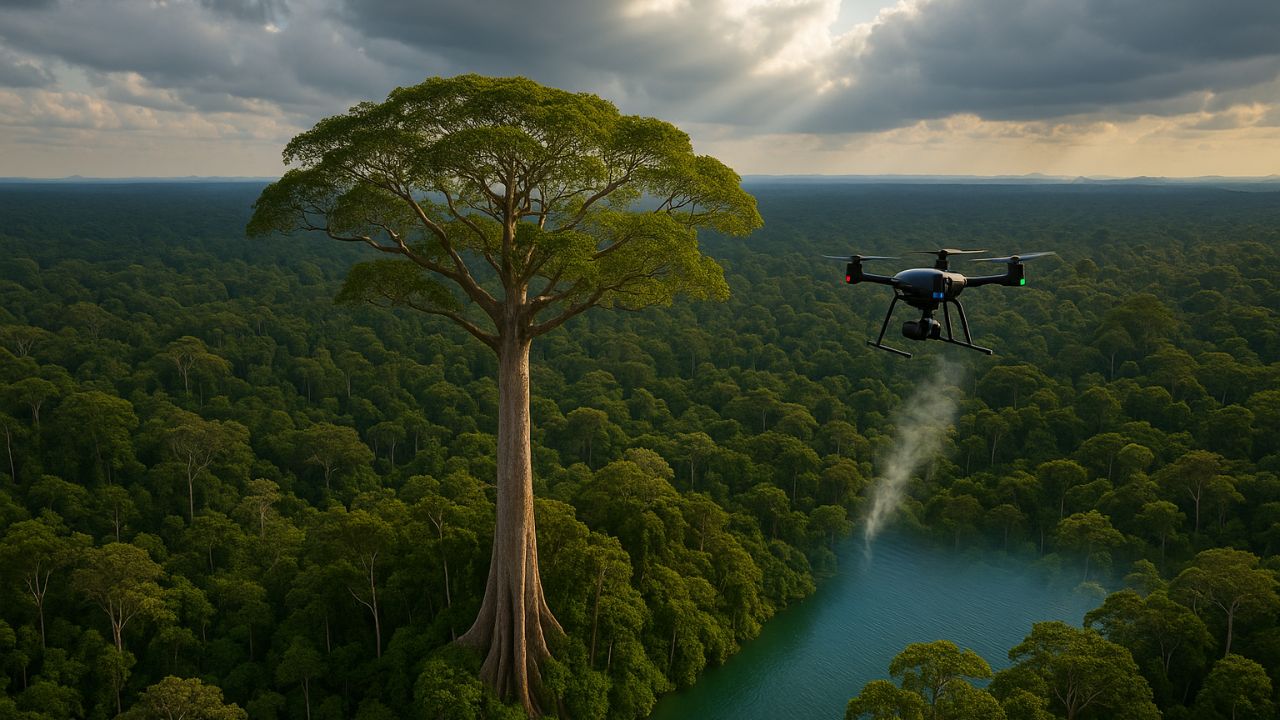
In the heart of the Amazon, a new generation of technology is emerging as one of nature’s strongest allies. Artificial intelligence and drones are transforming how Brazil monitors, protects, and restores its vast rainforest.
Technological advancements in woodland preservation
Once dependent on satellite images and ground patrols, Brazil’s environmental agencies are now integrating artificial intelligence (AI) and drone surveillance to safeguard the Amazon rainforest. This combination of technology and environmental science has created a powerful new model for forest protection—one that operates faster, more precisely, and at a scale that was once unimaginable.
The Amazon rainforest, spanning more than five million square kilometers, is home to over three million species of plants and animals. It also plays a crucial role in regulating the planet’s climate by absorbing carbon dioxide and releasing oxygen. Yet this vital ecosystem faces persistent threats from illegal logging, deforestation, and wildfires. Detecting and responding to these dangers in time has always been one of the greatest challenges for conservationists.
That is now changing. AI-driven systems, working in tandem with drones, are enabling authorities and researchers to identify signs of forest destruction almost in real time. Drones can fly over remote and inaccessible areas, capturing high-resolution images and data that AI algorithms analyze for irregular patterns—such as tree loss, smoke from fires, or illegal logging roads. This process allows for immediate alerts to be sent to local rangers or environmental officials, who can respond before the damage spreads.
A new frontier in environmental monitoring
Organizations such as the Brazilian Institute of Environment and Renewable Natural Resources (IBAMA), along with various non-governmental organizations, are dedicating more resources to artificial intelligence-driven solutions. These systems integrate satellite information with drone footage captured on-site, enabling them to pinpoint deforestation trends with remarkable accuracy. This advanced technology is capable of distinguishing between natural, seasonal tree loss and destructive human-induced activities.
Machine learning, a branch of AI, plays a crucial role in this transformation. By training algorithms on millions of images from both healthy and degraded forest areas, scientists have created models capable of identifying early indicators of ecological imbalance. These models can even predict where illegal deforestation is likely to occur next, allowing authorities to deploy resources proactively rather than reactively.
Some drones are equipped with thermal sensors and LiDAR (Light Detection and Ranging) systems, which can penetrate dense forest canopies and capture detailed topographical data. This information helps researchers track biodiversity, monitor the spread of forest fires, and assess the success of reforestation efforts. The integration of these technologies has led to a shift from traditional conservation methods to a more data-driven and predictive approach.
Collaboration between innovation and conservation
The triumph of this technological transformation relies not just on devices but also on the individuals who manage them. Native populations and local forest rangers, who have historically acted as custodians of the woodland, are receiving instruction in drone operation and the interpretation of AI-produced information. Their inherited understanding of the territory, coupled with sophisticated digital instruments, has demonstrated itself to be an effective synergy in safeguarding the Amazon’s fragile equilibrium.
Several Brazilian startups are also contributing to this mission. They are developing cost-effective drones that can cover vast areas and operate autonomously for hours, powered by renewable energy. Some of these companies are partnering with environmental organizations to create shared data platforms, where information collected from drones is automatically uploaded, analyzed, and visualized through interactive maps. These maps not only highlight areas under immediate threat but also track long-term environmental trends.
International cooperation has significantly bolstered these initiatives. Alliances with leading global technology companies and academic research centers have provided Brazil with access to advanced AI frameworks and cloud infrastructure capable of handling vast quantities of environmental information. This transnational teamwork has spurred rapid innovation, positioning Brazil as a leader in digital environmental protection.
From Oversight to Recovery
Technology’s role in the Amazon extends beyond surveillance. Drones are also being used in reforestation projects, dropping thousands of seed pods over deforested areas with remarkable precision. AI helps determine the best species combinations for specific soil and climate conditions, improving survival rates and biodiversity recovery. This automation not only speeds up the process but also reduces the cost and labor typically associated with manual planting.
Furthermore, AI models are helping scientists monitor the health of restored ecosystems. By analyzing data from drone images and environmental sensors, researchers can evaluate soil quality, tree growth rates, and the presence of animal life. Over time, this information provides a detailed understanding of how reforested areas evolve, which techniques are most effective, and where additional interventions may be needed.
These innovations are establishing a self-reinforcing cycle of monitoring, intervention, and evaluation—a process that is fundamentally altering how humans engage with the natural world. Through the synergistic operation of AI and unmanned aerial vehicles, the revitalization of forests can evolve into a more deliberate, quantifiable, and enduring endeavor.
The human and environmental impact
Beyond ecological benefits, the deployment of technology in the Amazon has profound social implications. For many rural communities, these innovations have created new job opportunities in data collection, drone operation, and environmental analytics. Programs designed to train local youth in digital skills have emerged, empowering a new generation of conservation technologists.
Moreover, the transparency enabled by AI and open data platforms has increased public awareness and accountability. Real-time deforestation alerts allow citizens, journalists, and environmental groups to track illegal activities and pressure authorities to take swift action. This level of visibility was unthinkable just a decade ago.
However, experts caution that technology alone cannot solve the complex challenges facing the rainforest. Effective policies, political will, and community engagement remain essential. Drones and AI provide powerful tools, but they must be integrated into a broader framework of sustainable development and forest governance.
Envisioning a sustainable tomorrow
The convergence of technological advancements and ecological principles provides a vision of the future of environmental preservation—not only within Brazil but globally. With the increasing pace of climate change, the demand for smart, expandable strategies to safeguard natural habitats has become more urgent than ever.
Brazil’s pioneering use of artificial intelligence and unmanned aerial vehicles establishes a benchmark for how countries can leverage technological advancements to safeguard their natural legacy. Through the integration of data science accuracy with a fervent commitment to environmental preservation, the nation is redefining the approach to protecting the planet’s most vital rainforest.
Within the immense Amazon, technology and people are collaborating towards a shared objective: safeguarding existence itself. With drones navigating above the canopy and algorithms deciphering the forest’s pulse, a fresh chapter in conservation is commencing—where innovation acts not to control nature, but to shield it.
